

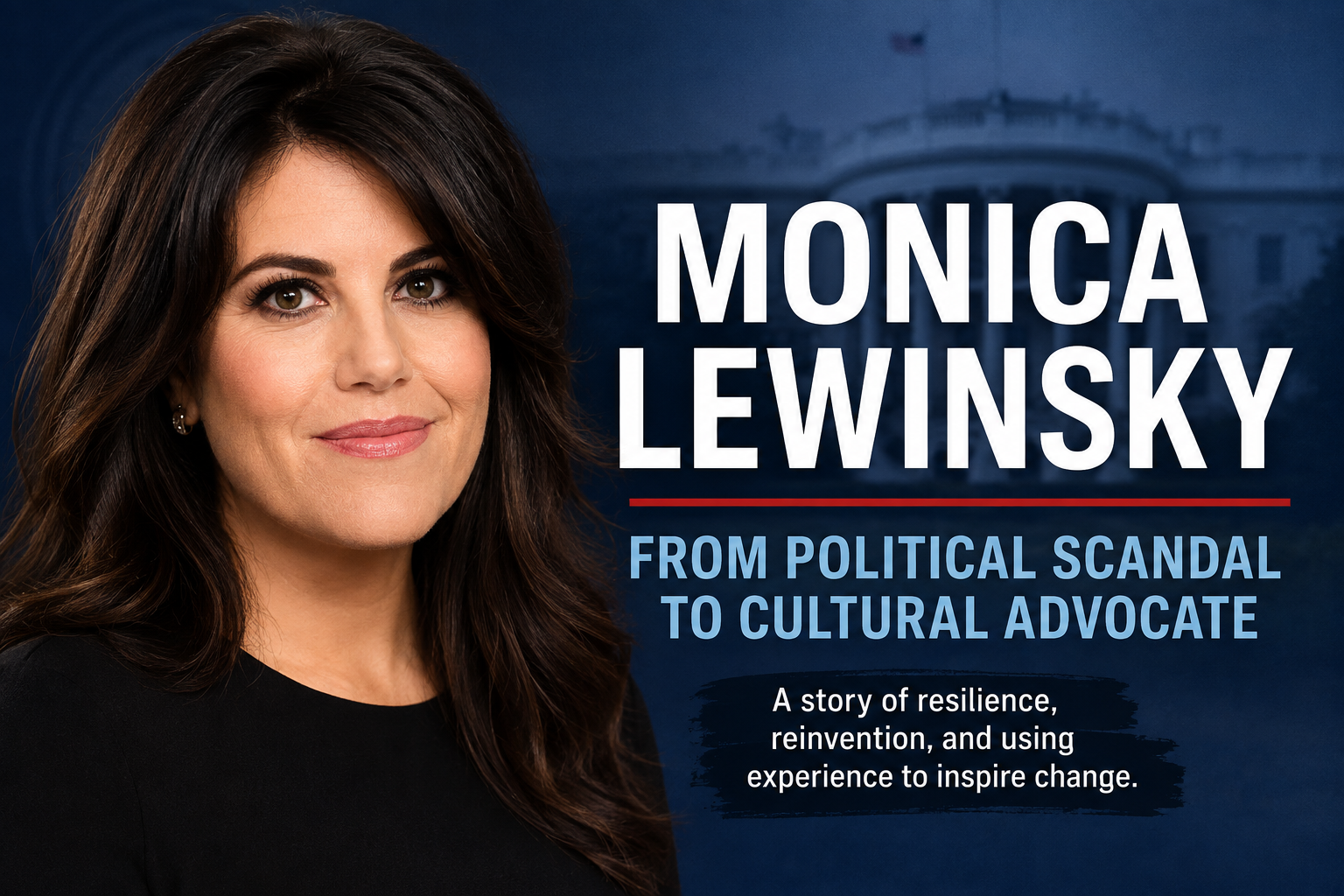
Monica Lewinsky is one of the most recognizable names associated with American political history, but describing her only through the 1998 scandal that made her famous leaves out much of the story. Today, Lewinsky is known as a social activist, writer, public speaker, and producer whose work focuses heavily on bullying, public humiliation, privacy, and the consequences of digital culture. TED describes her as an advocate for a safer and more compassionate social-media environment, drawing on her experience of becoming the focus of extraordinary public attention in the late 1990s.
Her journey is particularly relevant in the age of social media. What happened to Lewinsky occurred before platforms such as Facebook, Instagram, and TikTok existed, yet her experience anticipated many of the problems that dominate online culture today. Her story has therefore evolved from a political scandal into a broader conversation about shame, reputation, harassment, privacy, and the power of the internet.
Who Is Monica Lewinsky?
Early Life and Education
Monica Lewinsky was born in 1973 in San Francisco, California, and later attended Lewis & Clark College in Oregon. She eventually earned a master’s degree in social psychology from the London School of Economics and Political Science. TED notes that she spent years away from public attention before returning to the spotlight and using her experiences to address social issues.
That period of relative privacy is important because it shows that Lewinsky’s identity did not begin or end with the Clinton scandal. She pursued education, considered different professional paths, and spent years attempting to build a life outside the intense media attention that had followed her.
Her White House Years
In the 1990s, Lewinsky worked as a White House intern and later as an employee in Washington. Her relationship with President Bill Clinton became the subject of a federal investigation and eventually one of the most widely discussed political controversies of the decade. At only 24, she suddenly found herself at the center of an international media storm.
The 1998 Clinton Scandal
How the Story Became Public
The relationship between Lewinsky and Clinton became public in 1998 during an investigation connected to independent counsel Kenneth Starr. The revelation quickly transformed what had been a private matter into a major political story. Clinton denied aspects of the allegations before later acknowledging an inappropriate relationship with Lewinsky.
The scandal eventually became connected to Clinton’s impeachment by the U.S. House of Representatives. Yet for Lewinsky, the consequences were much more personal. Her name became a global punchline, and jokes about her appeared throughout popular culture.
The Media Frenzy
The late 1990s were a transitional period for journalism and the internet. Lewinsky’s story spread rapidly through television, newspapers, websites, and early online forums. TED describes her as an early target of what it calls a “culture of humiliation,” a phenomenon that has become even more recognizable in the social-media era.
Unlike today’s social-media personalities, Lewinsky had no ability to directly communicate with millions of people through a personal platform. Her public image was largely created by journalists, politicians, comedians, and commentators. That imbalance became an important part of the story she later chose to tell herself.
The Impact on Lewinsky
The intense public scrutiny had profound consequences for Lewinsky’s personal and professional life. She eventually withdrew from public life for years. In later interviews and writing, she has discussed the lasting effects of being publicly humiliated at such a young age.
Her experience also helped shape her understanding of online harassment. What once seemed like an unusual media phenomenon increasingly became familiar to millions of people as social networks made public criticism faster, more permanent, and easier to spread.
Life After the Scandal
Years Away From the Spotlight
After the scandal, Lewinsky explored different career opportunities while attempting to regain a degree of privacy. She also pursued academic study, completing her master’s degree in social psychology. Those years gave her distance from the events that had defined her public image.
For many people, the most significant part of her story is not the scandal itself but what happened afterward. She had to confront the difficult reality that the public can remember one chapter of someone’s life long after that person has moved on.
Returning to Public Life
Lewinsky returned to the public conversation more prominently in 2014, when she published a widely discussed essay in Vanity Fair. TED identifies that essay as an important moment in her return to public life.
Her return was different from her original appearance in the headlines. This time, she was speaking in her own voice. Instead of allowing others to define her story, she began explaining what the experience had actually been like from her perspective.
Monica Lewinsky and Cyberbullying
The Price of Shame
One of Lewinsky’s most important public appearances came with her 2015 TED Talk, “The Price of Shame.” The talk examines public humiliation and the way online culture can turn individual embarrassment into mass entertainment. TED reports that the presentation has received more than 22 million plays on its platform.
Her central argument remains striking because it asks audiences to consider the human being behind viral content. A joke may take seconds to post, but its consequences can remain with the target for years. In that sense, Lewinsky’s story became a warning about treating people as disposable characters in an endless online spectacle.
Becoming an Anti-Bullying Activist
Lewinsky has since become a prominent anti-bullying advocate and public speaker. Her work encourages people to challenge online harassment rather than simply watch it happen. TED describes her advocacy as an effort to create a safer and more compassionate social-media environment.
This message has become increasingly relevant as online platforms have grown. The technology changed, but the basic human behavior she describes has not: people can become remarkably cruel when they believe the person on the other side of a screen is distant or unreal.
Why Her Message Still Matters
Lewinsky’s experience offers a useful lesson for the digital age: public attention is not the same thing as public understanding. A person can become famous while remaining profoundly misunderstood.
Her advocacy encourages people to pause before sharing humiliating photographs, insulting comments, rumors, or personal information. That idea may sound simple, but in an environment built around speed and engagement, choosing empathy can be surprisingly powerful.
Monica Lewinsky as a Writer and Producer
Vanity Fair and Personal Storytelling
Lewinsky became a contributing editor at Vanity Fair, where she has written about politics, culture, personal experiences, and social issues. Her current contributor page lists her as an anti-bullying activist, global public speaker, and producer.
Her recent work demonstrates that her interests extend well beyond the events of 1998. In February 2026, for example, Vanity Fair published her commentary discussing the Epstein files and the nuances of grooming.
Alt Ending Productions
Lewinsky has also expanded into producing through Alt Ending Productions, giving her another way to participate in storytelling. This is significant because production allows her to help shape narratives rather than simply respond to narratives created about her.
Monica Lewinsky in Popular Culture
Reclaiming Her Narrative
For decades, Lewinsky’s name was used primarily as shorthand for a political scandal. Her later work has challenged that narrow definition. Her 2025 podcast project, Reclaiming, was presented as another step in a broader effort to show that her life contains much more than the events of her twenties.
The idea of reclaiming a narrative is central to her public evolution. Instead of pretending the past never happened, Lewinsky has increasingly confronted it while refusing to let it become the only story people can tell about her.
The Importance of Representation
Lewinsky’s transformation also reflects a broader cultural shift. Conversations about power, workplace relationships, consent, gender, and public shaming have changed significantly since the 1990s.
Her story is now frequently examined through a more complicated lens than it was at the time. That does not erase the choices made by the adults involved, but it does encourage society to consider power differences, media responsibility, and the human consequences of turning private behavior into mass entertainment.
What Monica Lewinsky Is Doing Today
Recent Writing and Creative Projects
As of 2026, Lewinsky remains active as a writer, speaker, and producer. Her Vanity Fair contributor profile lists recent work from 2025 and 2026, demonstrating that she continues to participate in cultural and social discussions.
Her career today is therefore considerably broader than the image many people first encountered in the 1990s. She has transformed a painful chapter of her life into a platform for discussing digital cruelty, public shame, personal agency, and storytelling.
Monica Lewinsky’s Lasting Legacy
Lessons From Her Story
Monica Lewinsky’s legacy is complicated precisely because it crosses politics, journalism, celebrity culture, feminism, and technology. Her story demonstrates how quickly a private event can become a public spectacle and how difficult it can be for someone to escape a reputation created during a single moment in their youth.
Her later career provides another lesson: reinvention does not necessarily mean forgetting the past. Sometimes it means taking control of how that past is understood.
Conclusion
Monica Lewinsky’s life cannot be reduced to a single scandal. She became famous under extraordinary circumstances, endured years of ridicule and public scrutiny, stepped away from the spotlight, and eventually returned as an advocate for a more humane digital culture. Her TED work, writing, and producing career show a deliberate effort to transform personal experience into something socially useful.
In an era when a photograph, comment, or mistake can become viral within minutes, her story feels remarkably current. Perhaps the most important lesson is simple: behind every trending story is a real person. Lewinsky’s evolution from a media target into an advocate for empathy and accountability makes her story relevant far beyond the political controversy that first made her famous.
Frequently Asked Questions
1. Who is Monica Lewinsky?
Monica Lewinsky is an American social activist, writer, public speaker, and producer who became internationally known after her relationship with President Bill Clinton became public in 1998. She later became a prominent advocate against bullying and online public shaming.
2. What is Monica Lewinsky known for today?
Today, Lewinsky is particularly known for her work addressing cyberbullying, public humiliation, privacy, and social-media culture. She is also a writer and producer.
3. What was Monica Lewinsky’s TED Talk about?
Her 2015 TED Talk, “The Price of Shame,” explored public humiliation and online harassment, drawing heavily on her own experience of becoming the target of global public scrutiny.
4. Does Monica Lewinsky still write?
Yes. Her Vanity Fair contributor profile identifies her as a contributing editor and lists articles she published as recently as February 2026.
5. Why is Monica Lewinsky still relevant?
Lewinsky’s experience anticipated many issues associated with modern internet culture, including viral humiliation, cyberbullying, privacy violations, and the difficulty of controlling one’s public image. Her continuing advocacy keeps those issues in the public conversation.