

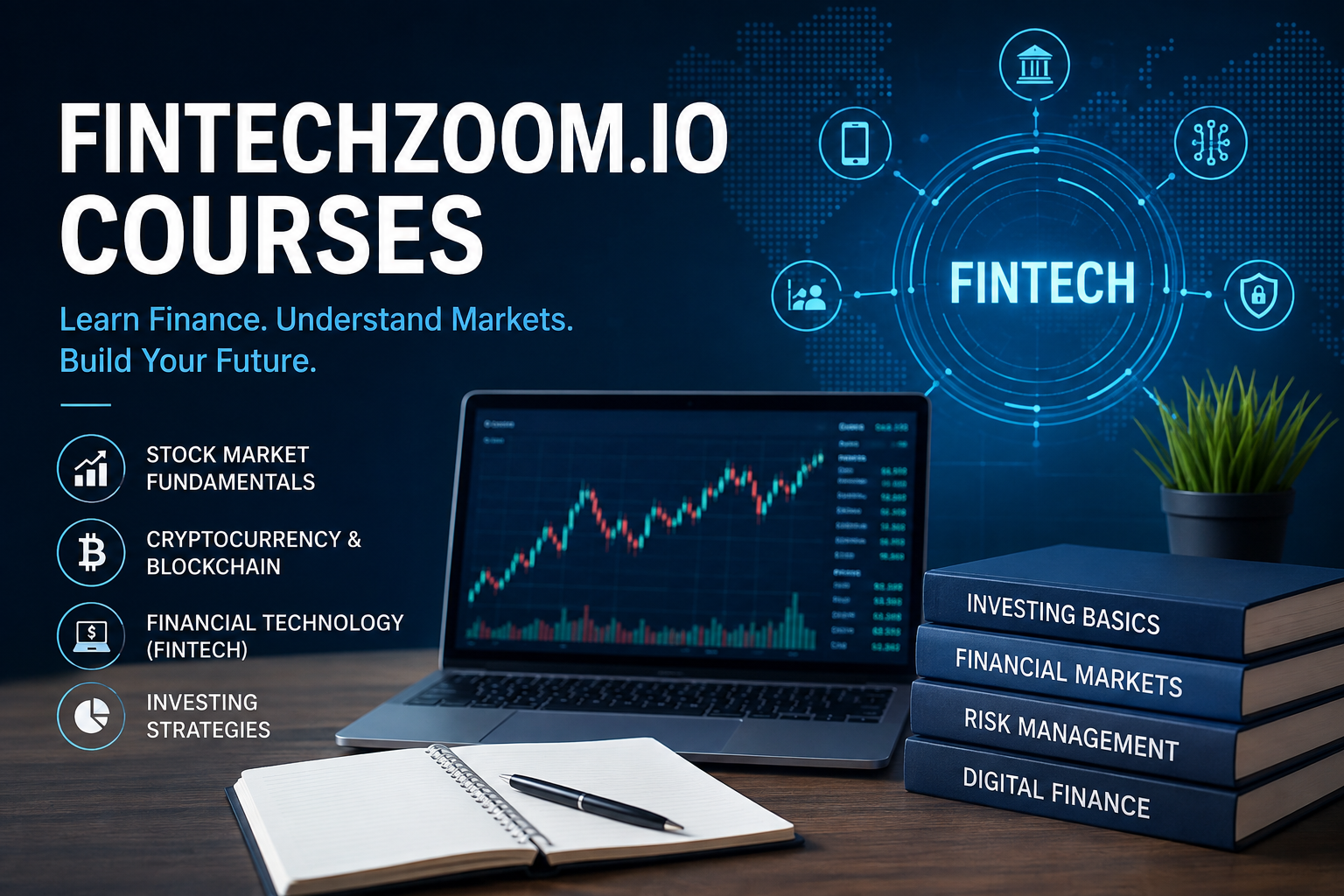
If you are searching for FintechZoom.io courses, you are probably looking for a straightforward way to learn about finance, investing, markets, or financial technology without getting buried in complicated academic language. The first thing to understand, though, is that course availability can change, and the phrase “FintechZoom.io courses” may refer to educational material associated with FintechZoom rather than a single, clearly defined course catalog. A current search is therefore useful before paying for or relying on any specific program.
What Are FintechZoom.io Courses?
The term FintechZoom.io courses is commonly used in searches by people interested in learning financial concepts through online resources connected with the FintechZoom ecosystem. FintechZoom has built an online presence around financial markets, business, technology, cryptocurrencies, stocks, and related topics, making it attractive to readers who want accessible financial information.
For a beginner, this type of learning can be appealing because financial education does not always need to begin with a textbook hundreds of pages long. You might start by understanding basic investing terminology, then move toward market analysis, digital finance, cryptocurrency, or fintech applications. Think of it like learning to drive: you do not need to understand how every component inside an engine works before learning how to operate a car safely.
What Can You Learn From FintechZoom’s Educational Content?
The subjects associated with FintechZoom can cover several areas of modern finance. Depending on the specific educational resource you find, the material may be useful for developing familiarity with topics such as:
- Stock market fundamentals
- Personal finance
- Investment concepts
- Cryptocurrency
- Blockchain technology
- Financial technology
- Market trends
- Business and economic developments
- Trading terminology
- Digital banking
The biggest advantage for beginners is context. Financial terms can seem meaningless when studied in isolation. When you encounter them alongside explanations of real markets and businesses, they become easier to understand.
For example, learning what market capitalization means is useful. Seeing how market capitalization changes when a company’s share price moves can make the concept much more memorable.
Are FintechZoom.io Courses Suitable for Beginners?
They can be useful for beginners, particularly if your goal is to develop general financial literacy rather than immediately become a professional analyst. Someone who has never studied investing may benefit from starting with basic terminology before attempting advanced financial models.
However, beginners should distinguish between financial education and financial advice. Educational material can explain how an investment works, but that does not automatically mean the information tells you what you should buy or sell.
A sensible learning path is to build knowledge gradually. Start with financial vocabulary, learn how markets operate, understand risk and diversification, and only then explore more specialized areas such as technical analysis, options, cryptocurrencies, or algorithmic trading.
Fintech and Financial Technology
One particularly interesting area is fintech, short for financial technology. Fintech has changed how people pay, borrow, save, invest, and manage money.
Mobile banking is a simple example. Instead of visiting a branch to check an account balance, customers can perform many banking tasks from a smartphone. Digital wallets, online payment systems, automated investing platforms, blockchain applications, and financial APIs are other examples of technology reshaping financial services.
A good fintech course or educational resource should therefore do more than define the word “fintech.” Ideally, it should help learners understand the relationship between technology, financial institutions, consumers, regulation, cybersecurity, and business models.
How to Evaluate a FintechZoom.io Course
Before enrolling in anything advertised as a FintechZoom.io course, take a few minutes to evaluate it carefully. Do not judge a course solely because it appears prominently in search results or uses a recognizable financial brand.
Look for information about the instructor, curriculum, learning objectives, course duration, pricing, refund policy, and the date the material was last updated. Finance changes quickly, so outdated examples can become misleading.
A useful comparison looks something like this:
| Factor | What to Check |
|---|---|
| Curriculum | Are the topics clearly explained? |
| Instructor | Does the teacher have relevant expertise? |
| Updates | Is the content maintained regularly? |
| Practical work | Are there examples, exercises, or projects? |
| Cost | Is the price reasonable for the material? |
| Certification | Is a certificate actually useful for your goal? |
| Reviews | Are independent learner experiences available? |
This simple checklist can prevent you from buying a course based on marketing alone.
FintechZoom Courses vs. Traditional Finance Courses
Online financial education has one major advantage: flexibility. You can study during a lunch break, after work, or whenever your schedule allows. Traditional courses may offer greater interaction with instructors and classmates, but online resources can be easier to fit around a busy lifestyle.
The right choice depends on your objective. If you simply want to understand investing and financial technology, an online course may be enough. If you are pursuing a university qualification, professional certification, or finance career, you may need a more structured educational program with recognized credentials.
The certificate itself should not be the main attraction. Knowledge is the real asset. A certificate might decorate your résumé, but practical understanding is what helps you answer questions, analyze information, and make better decisions.
How to Get More Value From Online Finance Courses
Simply watching lessons is rarely enough. Financial concepts become much easier to remember when you actively work with them.
After learning a concept, try explaining it in your own words. If you cannot explain it simply, you probably need to revisit the lesson. You can also create a small glossary of unfamiliar terms, follow a few real companies, and practice reading financial news without immediately trying to trade.
Most importantly, separate learning from investing. You do not need to put money at risk just because you have learned a new strategy. Paper trading, spreadsheets, case studies, and hypothetical portfolios can provide useful practice while you build confidence.
Is FintechZoom.io Worth Exploring?
For people interested in financial markets and fintech, FintechZoom-related educational material can be a useful starting point. Its greatest potential value is as part of a broader learning strategy rather than as a substitute for every form of financial education.
Before spending money, verify that the specific course currently exists, check who provides it, examine the syllabus, and compare it with established alternatives. A course should solve a particular learning problem for you—not simply promise quick financial success.
The strongest approach is to treat online courses as tools in your financial education toolkit. Combine structured lessons with books, reputable financial institutions, practical exercises, and current market information. Over time, that combination can produce much deeper understanding than relying on one website alone.
Conclusion
FintechZoom.io courses can be an interesting search area for anyone trying to improve their understanding of finance, investing, and financial technology. The important question is not simply whether a course carries the FintechZoom name; it is whether the specific material is current, credible, practical, and appropriate for your level.
Start with fundamentals, question financial claims, compare educational options, and avoid courses that promise effortless profits. Finance rewards patience and critical thinking far more reliably than shortcuts.
FAQs
1. What are FintechZoom.io courses?
The phrase generally refers to educational resources or courses associated with searches for FintechZoom and subjects such as finance, investing, markets, cryptocurrency, and fintech. Availability and offerings should be verified before enrollment.
2. Are FintechZoom courses good for beginners?
They may be useful for beginners who want an introduction to financial concepts, but learners should check the specific curriculum and instructor before choosing a course.
3. Do FintechZoom courses provide certificates?
Certificate availability depends on the particular course or provider. Always verify whether a certificate is offered and whether it has meaningful recognition in your intended field.
4. Can a fintech course teach me how to invest?
A course can teach investing concepts, terminology, analysis methods, and risk-management principles. Education should not be confused with personalized investment advice or guaranteed returns.
5. What should I learn before studying fintech?
Basic financial literacy is a helpful starting point. Understanding banking, investments, markets, risk, economics, and basic technology concepts can make more advanced fintech topics easier to understand.