

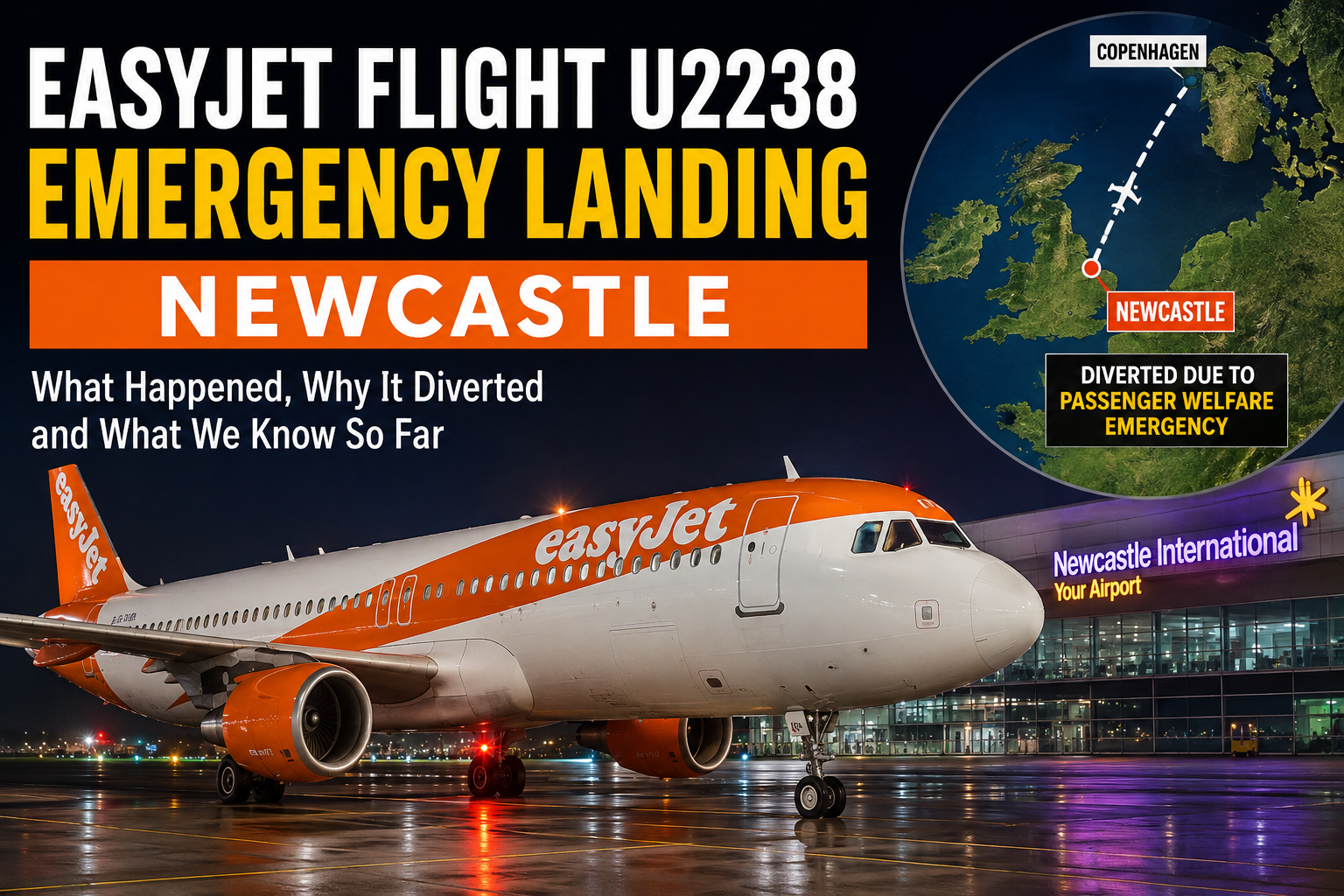
The term “easyJet flight U2238 emergency landing Newcastle” has garnered a lot of interest on the internet, but before delving into the incident itself, it is crucial to make clear that easyJet U22238, not U2238, was the aircraft involved in the widely reported Newcastle diversion. A different easyJet route called Flight U2238 typically travels between Newcastle and Bristol. According to current flight history data, U2238 was using that route in July 2026; however, reports of the emergency diversion pertain to U22238, which was en way from Copenhagen to Manchester.
The event occurred on October 27, 2025, when the crew reported a passenger welfare or medical emergency, causing the Copenhagen-to-Manchester flight to be diverted to Newcastle Airport. The passenger was treated by paramedics after the Airbus A320 made a safe landing in Newcastle. After the aircraft was dealt with on the ground, the flight proceeded to Manchester.
What took place on the EasyJet flight?
Instead of Newcastle, the plane was flying from Copenhagen, Denmark, to Manchester, UK. The airplane left Copenhagen at around 22:13 Central European Time, following a delayed departure, and was crossing the North Sea when the incident occurred, according to current aviation reports. Given the airport’s location and capacity to handle an aircraft in need of priority assistance, the crew made the sensible option to declare an emergency and divert toward Newcastle.
The aircraft reportedly landed at Newcastle at around 22:52 GMT on runway 25. Once it reached the airport, the aircraft taxied to the gate and medical personnel attended the passenger. This is an important distinction because the term “emergency landing” can sound much more dramatic than the actual circumstances: the available reporting indicates that this was a precautionary diversion caused by a passenger medical or welfare issue, not a crash or an aircraft accident.
Why Was the Flight Diverted to Newcastle?
The stated reason for the diversion was a passenger welfare issue. easyJet reportedly apologised to passengers and explained that the diversion was outside the airline’s control because of the medical situation onboard. The exact medical condition of the passenger was not publicly detailed in the reports, and there is no reliable basis for speculating beyond the information provided by the airline and aviation reporting.
For airlines, a medical emergency can require quick decision-making. A crew may assess whether the passenger needs treatment that cannot safely wait until the scheduled destination. If so, the aircraft can divert to a suitable airport where emergency medical services are available. In this case, Newcastle provided an appropriate alternative to continuing south toward Manchester.
Timeline of the Newcastle Emergency Landing
The reported sequence is relatively straightforward. The easyJet aircraft departed Copenhagen later than its scheduled departure time, then continued toward Manchester. While flying over the North Sea, the crew declared an emergency because of the passenger welfare situation and changed course for Newcastle.
The Airbus A320 landed at Newcastle at approximately 22:52 GMT. Medical personnel then attended the passenger while the aircraft remained on the ground. After the situation had been handled, the aircraft continued its journey to Manchester, eventually arriving at approximately 00:28 GMT on 28 October.
That timeline helps explain why reports describing the event as an “emergency landing” should not automatically be interpreted as an indication of an aircraft failure. The available information points instead to a diversion made to obtain medical assistance.
Did the Emergency Affect Other Flights?
The diversion also had a knock-on effect at Newcastle Airport. Reports indicated that an Air France flight was placed into a holding pattern while the easyJet aircraft was given priority to land. This illustrates how an emergency diversion can affect airport operations even when the aircraft itself is not experiencing a mechanical problem.
Airports and air-traffic controllers routinely have procedures for prioritising aircraft dealing with emergencies. Other aircraft may need to circle, adjust their approach times, or wait for runway availability. From a passenger’s perspective, that can result in unexpected delays, but giving an aircraft priority during a genuine emergency is a normal part of aviation safety.
What Happened After the Aircraft Landed?
Once the easyJet aircraft arrived at Newcastle, paramedics took over the medical aspect of the situation. The aircraft remained on the ground while the passenger received the necessary attention. According to the aviation report, the plane later departed Newcastle and continued toward Manchester.
This outcome is significant because it demonstrates that a diversion does not necessarily mean the flight is cancelled. Depending on the circumstances, an aircraft can be refuelled, checked and cleared to continue its journey. In this case, the available reporting indicates that passengers eventually reached Manchester after the Newcastle stop.
U2238 vs U22238: An Important Difference
People searching for “easyJet flight U2238 emergency landing Newcastle” should be particularly careful with the flight number. Current flight-tracking records identify U2238/EZY238 as the Newcastle-to-Bristol service, with recent operations showing it flying from Newcastle Airport to Bristol.
The emergency diversion reported in October 2025 involved U22238/EZY2238, the Copenhagen-Manchester service. The similarity between the numbers makes it easy for search results, social-media posts and secondary articles to create confusion. For anyone researching the event, checking the complete flight number is therefore essential.
Was This a Crash or Aircraft Failure?
No. The available reports do not describe the event as a crash, forced landing caused by aircraft damage, or major aviation accident. Instead, the aircraft was diverted because of a passenger welfare emergency. It landed safely at Newcastle and later continued to Manchester.
That distinction matters. In aviation terminology, an emergency declaration does not automatically mean an aircraft is about to crash. Crews can declare an emergency when they require priority handling or when a situation onboard means landing at the planned destination is no longer the safest option.
What Passengers Can Learn From the Incident
The Newcastle diversion is a useful reminder of how aviation safety works behind the scenes. When a serious medical situation occurs, pilots and cabin crew have to balance the needs of the affected passenger with the safety of everyone onboard. Diverting to an airport with suitable emergency services can be the most responsible decision, even when that means passengers arrive later than planned.
For travellers, the key takeaway is that an emergency diversion can be a safety measure rather than a sign that an aircraft is unsafe. In this case, the aircraft reached Newcastle safely, medical assistance was provided, and the service subsequently continued to Manchester.
Conclusion
The easyJet flight U2238 emergency landing Newcastle search term is slightly misleading because the widely reported incident actually involved U22238, not U2238. The aircraft was travelling from Copenhagen to Manchester when a passenger welfare emergency prompted the crew to declare an emergency and divert to Newcastle Airport. It landed safely, medical personnel attended the passenger, and the aircraft later continued to Manchester.
Meanwhile, U2238 is a different easyJet flight operating between Newcastle and Bristol, according to current flight-history records. Understanding that distinction prevents an important factual error when discussing the Newcastle emergency landing.
FAQs
1. Did easyJet flight U2238 make an emergency landing in Newcastle?
The widely reported incident involved U22238, not U2238. U22238 was travelling from Copenhagen to Manchester and diverted to Newcastle because of a passenger welfare emergency. U2238 is a separate Newcastle-to-Bristol service.
2. Why did the easyJet aircraft land at Newcastle?
The aircraft diverted because of a medical or passenger welfare emergency. Newcastle was used as a suitable airport where medical assistance could be provided quickly.
3. Was the easyJet aircraft damaged?
Available reporting does not indicate that the aircraft was damaged. The diversion was associated with a passenger medical situation rather than a reported aircraft accident.
4. Did the flight eventually reach Manchester?
Yes. After landing at Newcastle and dealing with the passenger welfare situation, the aircraft continued to Manchester and arrived shortly after midnight on 28 October 2025.
5. Is U2238 still a Newcastle-to-Bristol flight?
Current flight-history information identifies U2238/EZY238 as an easyJet service from Newcastle to Bristol, helping distinguish it from the U22238 emergency diversion.