

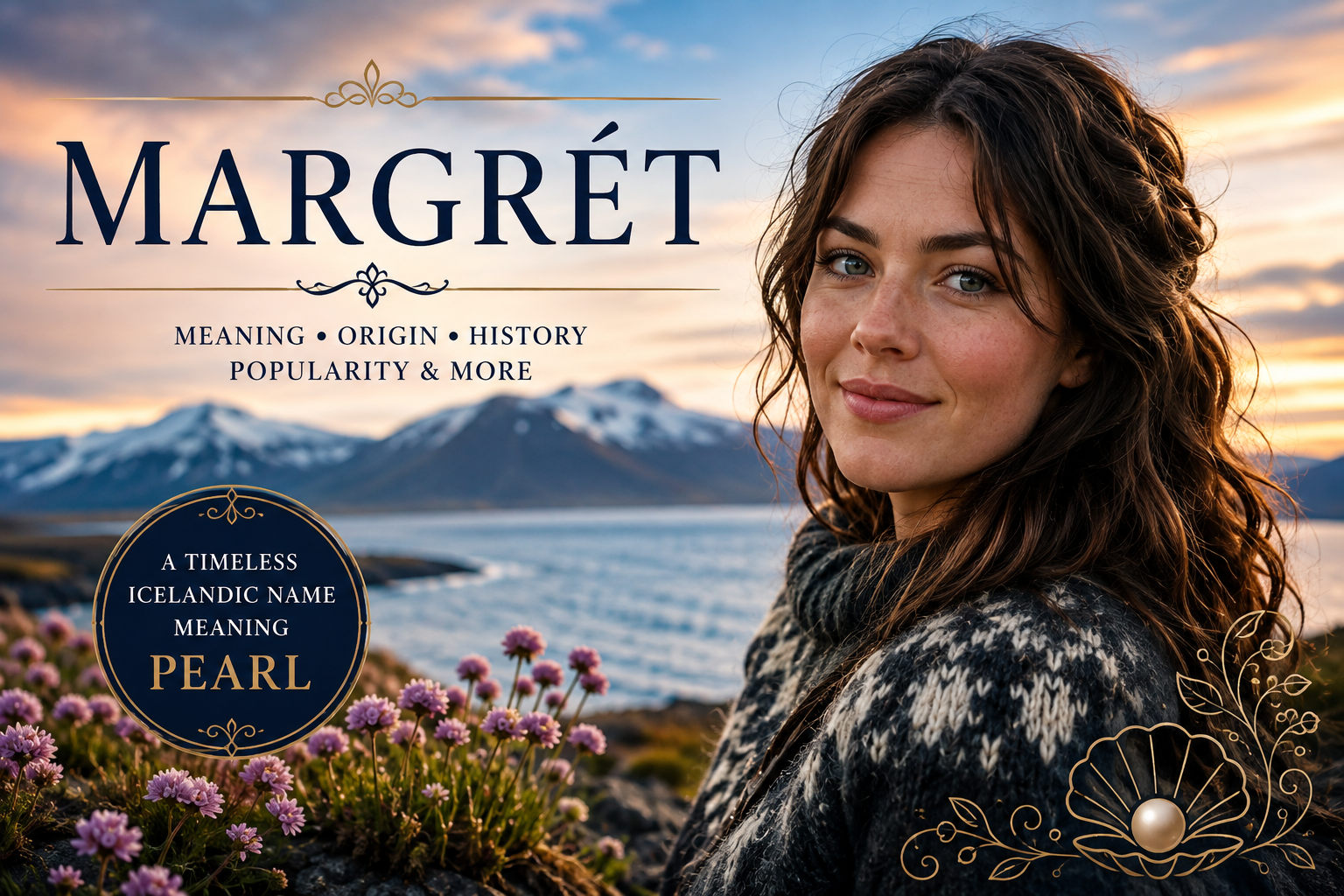
The name Margrét has a distinctive sound that immediately evokes Iceland, Nordic culture, and a long European naming tradition. Although it may look unusual to English-speaking readers because of the accent over the final é, Margrét is actually part of a much larger family of names that includes Margaret, Margareta, Marguerite, Margarita, Margarethe, and Margit. Its story stretches back far beyond modern Iceland, connecting an ancient Greek word for “pearl” with centuries of Christian history and eventually with the unique naming culture of Iceland.
For someone searching for the meaning of Margrét, there is therefore more to discover than a simple dictionary definition. The name carries linguistic history, religious associations, Nordic identity, and a surprisingly strong connection with Icelandic culture. Current information from Statistics Iceland also shows how seriously Iceland treats personal names: the national statistics system tracks first names, second names, double names, historical development, and population data, making names an unusually visible part of the country’s demographic record.
So, what makes Margrét special? Think of it as an old European pearl that has been polished differently in every language. The underlying gem remains recognizable, but its shape, pronunciation, and cultural associations change from country to country. In Iceland, that gem became Margrét, a feminine given name that feels traditional without being trapped in the past.
What Does the Name Margrét Mean?
The most widely established meaning of Margrét is “pearl.” The Icelandic name is the Icelandic form of Margaret, which ultimately comes through Latin Margarita from the Greek margarítēs, meaning “pearl.” The Icelandic name reference Veldu nafn similarly connects Margrét with the Greek Margarites and gives the traditional pearl interpretation.
That meaning gives Margrét a particularly elegant symbolic foundation. A pearl is not flashy in the way a gemstone covered in glitter might be flashy; instead, its appeal comes from smoothness, rarity, and the way it develops gradually. A pearl begins inside an oyster and is formed layer by layer, which makes it an easy metaphor for patience, resilience, maturity, and quiet beauty. Those qualities have naturally become associated with the name in modern interpretations, even though they should be understood as symbolism rather than a scientific description of someone’s personality.
The pearl meaning also helps explain why the name has survived for so long. Names connected with precious objects tend to have an enduring emotional appeal. A name meaning “pearl” can sound refined without being excessively ornate, and Margrét has exactly that balance. It has a firm Nordic character while retaining the softness found in many forms of Margaret.
The Meaning of “Pearl”
The symbolism of the pearl is especially interesting because it is universal. Pearls have been valued across civilizations for thousands of years, and their natural formation gives them a story that is almost tailor-made for human symbolism. Unlike a gemstone that is simply cut from rock, a pearl develops gradually inside a living creature. That makes it an unusually powerful image for something precious that emerges through time and transformation.
When the meaning of Margrét is described as “pearl,” therefore, the word can carry several layers of association: beauty, rarity, endurance, refinement, and something valuable that develops rather than appearing instantly. It is one reason the name can feel both gentle and substantial. There is nothing aggressive about the imagery, yet a pearl is not fragile in the symbolic sense; it represents something that has acquired value through a long process.
Veldu nafn also records an older folk interpretation that plays with the Icelandic components of the word and associates the name with the poetic idea of “tears of the sea.” The same source ultimately returns to the pearl meaning, reinforcing the connection between Margrét and the sea.
How the Name Developed Linguistically
The linguistic journey behind Margrét resembles a long relay race. The original Greek term passed into Latin and then spread through European languages, with each language adapting the pronunciation and spelling to its own sound system. Margaret became established in English, Marguerite in French, Margarita in Spanish and other languages, Margareta in several European traditions, and Margrét in Icelandic.
This is important because Margrét is not an isolated name invented independently in Iceland. It is a local form of a very old international name. What makes the Icelandic version distinctive is the combination of the original historical heritage with Icelandic spelling and pronunciation.
The Origin of Margrét
The deepest origin of Margrét can be traced to ancient Greek. The Greek word margarítēs meant “pearl,” and the name eventually traveled through Latin and Christian Europe. The historical popularity of Margaret was strongly influenced by Saint Margaret of Antioch, a fourth-century Christian martyr who became an important medieval saint. Later traditions associated her with a dragon, and medieval artistic representations frequently depicted her in connection with that story.
That religious history matters because medieval saints played an enormous role in the spread of personal names throughout Europe. A name could begin as an ordinary word, become associated with a saint, and then be passed through generations because parents wanted to honor that religious figure. Over hundreds of years, the name could become so established that people no longer thought about its original religious connection. Margaret followed precisely this kind of path.
Eventually, versions of the name appeared throughout Europe. The result is the remarkable collection of related forms found today: Margaret, Margret, Margrét, Margareta, Marguerite, Margarita, Margarethe, Margit, Margaretta, and many others.
From Ancient Greek to Icelandic
The journey from ancient Greek to modern Icelandic is a perfect example of how languages preserve history while reshaping it. Icelandic belongs to the North Germanic language family and has maintained many distinctive spelling and grammatical traditions. When an international name becomes part of Icelandic usage, it is adapted according to Icelandic linguistic conventions rather than simply copied from English.
That is why Margrét looks familiar and unfamiliar at the same time. Someone who knows Margaret can immediately recognize the family resemblance, yet the accent and spelling signal a different linguistic environment. The final é is not decorative; it belongs to the Icelandic form of the name.
This linguistic continuity is one of the most fascinating things about Icelandic names. A name can be internationally recognizable while still retaining a strongly local identity. Margrét is therefore both a European name and an unmistakably Icelandic one.
Margrét and the Icelandic Naming Tradition
To understand Margrét properly, it helps to understand Iceland’s unusual approach to names. Icelandic naming culture has historically placed a strong emphasis on given names and patronymic or matronymic naming rather than the hereditary family surnames common in many other countries. Statistics Iceland’s research into naming practices shows that Icelandic naming has distinctive patterns involving inherited given names, patronymics, matronymics, and relatively limited use of conventional family names.
This makes a name such as Margrét more than a label. It can function as an important part of personal and cultural identity. Icelanders are famously comfortable referring to people by their first names, including prominent public figures, and this cultural habit gives first names an unusually visible role in everyday life. Modern explanations of Icelandic naming practices likewise emphasize the importance of first names in Icelandic identity.
In many countries, a person’s surname may dominate how they are identified formally. Iceland works differently. A familiar first name can remain central to someone’s identity even when the second element of the full name changes according to parentage. That context gives traditional names such as Margrét a cultural weight that may be easy to miss if the name is viewed only through an English-language naming guide.
Why Icelandic Names Are Different
Iceland’s naming system developed from historical Scandinavian traditions and evolved within a relatively small population. Rather than relying overwhelmingly on a fixed set of hereditary surnames, many Icelanders have names connected to their parentage. A person’s name can therefore tell you something about family relationships while still preserving the individual’s distinctive given name.
Statistics Iceland has documented how naming practices have changed across generations. Its data series on names extends continuously from 1978, with earlier historical information derived from national censuses. Current name statistics are based on population data, while the organization also provides separate information about first names, second names, double names, and name popularity.
First Names, Family Names, and Identity
The importance of first names helps explain why a traditional feminine name such as Margrét can remain culturally meaningful even as naming fashions change. A name does not need to dominate the list of newborn names every year to remain part of the national naming landscape. Established names can persist because grandparents, parents, historical figures, literature, and cultural memory continue to give them relevance.
Icelandic naming is also unusually well documented. Statistics Iceland’s research found that a relatively small group of given names accounts for a large share of the population, while inherited names remain an important feature of family continuity. In one analysis, more than 35% of people under 30 had inherited some part of a grandparent’s given name.
That context makes Margrét feel less like a random traditional name and more like one thread in a larger cultural fabric. The name connects individual identity with language, family history, and Icelandic tradition.
How Popular Is Margrét in Iceland?
Margrét has a substantial historical presence in Iceland. Current name information published by Icelandic sources shows thousands of people carrying the name. The Icelandic name database Veldu nafn lists 4,613 people with Margrét as a first or second name, including 2,748 people with Margrét as a first name according to its displayed population figures.
Independent name databases also place Margrét among Iceland’s more established female given names. Forebears, for example, lists Margrét as one of the country’s prominent first names and estimates more than 2,500 bearers in its dataset. Because different databases use different collection methods and dates, these figures should not be treated as interchangeable official counts, but they agree on the broader point: Margrét is a well-established Icelandic name rather than an obscure spelling variant.
The official Statistics Iceland name system is the better reference for current Icelandic population statistics because its name data are derived from Icelandic population records. The current system states that its latest results are based on population data from 1 January 2025, while its historical series provides a much longer view of how names have developed over time.
Historical Popularity
Margrét has appeared prominently in Icelandic naming statistics over time. A Statistics Iceland release reported that Margrét was the most frequent name given to female children born in 2014, illustrating that the name has not simply survived as an old-fashioned choice; at least in some recent periods, it has remained a strong choice for newborn girls.
Historical data also show Margrét among Iceland’s leading female names. A Statistics Iceland publication using 2009 population data placed Margrét fifth among female first names, accounting for 1.91% of the female population in that table.
These figures tell an interesting story. Margrét is traditional, but traditional does not necessarily mean outdated. Like a well-made coat that survives changing fashion, the name has enough structural strength to remain recognizable across generations.
Margrét in Nordic and European Culture
Margrét belongs to a huge European naming family. Its relatives appear across Scandinavia, continental Europe, the British Isles, and beyond. The precise spelling changes, but the historical core remains recognizable. In Danish and Norwegian traditions, forms such as Margrethe and Margit are familiar; Swedish uses forms including Margareta and Margit; German has Margarete, Margarethe, and Margret; French has Marguerite; Spanish and Italian use Margarita and Margherita.
That diversity makes Margrét a particularly interesting name for families interested in heritage. Choosing it can connect someone to Iceland while also connecting them to a much broader European tradition. It is similar to owning an old musical melody that has been rearranged in different countries: the rhythm and instrumentation may change, but listeners can still recognize the original theme.
The Icelandic spelling adds another layer. The accented é immediately distinguishes the name from the English Margaret or the German Margret. For people interested in language, that detail can make Margrét especially appealing because the spelling preserves its local identity rather than flattening it into an internationally standardized version.
Variations of Margrét Around the World
Here are some of the most recognizable relatives of Margrét:
| Language or tradition | Related form |
|---|---|
| Icelandic | Margrét |
| English | Margaret |
| French | Marguerite |
| Spanish | Margarita |
| Italian | Margherita |
| German | Margarete / Margarethe / Margret |
| Swedish | Margareta / Margit |
| Danish | Margrethe / Margit |
| Norwegian | Margrete / Margit |
| Polish | Małgorzata |
| Hungarian | Margit / Margaréta |
The list could be extended much further because the name has traveled across numerous linguistic communities.
What stays remarkably consistent is the association with the original pearl meaning. Pronunciation evolves, spelling changes, and cultural associations accumulate, but the central linguistic root remains visible.
Famous People Named Margrét
One reason names survive is that real people give them personality. Iceland has produced numerous notable women named Margrét, including figures from sports, arts, public life, and society. The name is therefore not restricted to one profession or social category.
For example, Margrét Rósa Hálfdánardóttir is an Icelandic basketball player, demonstrating the name’s presence in contemporary Icelandic sport. Other individuals carrying the name have appeared in Icelandic public and cultural life, reinforcing the fact that Margrét is not simply a historical name found in old records.
There is also Margrét Þóra Hallgrímsson, an Icelandic socialite and aristocrat who lived from 1930 to 2020 and became associated with prominent Icelandic business and cultural circles. Her biography reflects another dimension of the name’s historical visibility in Icelandic society.
The wider Margaret family is even more famous. Saints, queens, writers, artists, political figures, athletes, and fictional characters have all carried forms of the name. This broad cultural footprint gives Margrét a sense of inherited significance without requiring every modern bearer to identify with any particular historical figure.
How to Pronounce Margrét
For English speakers, Margrét can initially look more complicated than it sounds. The name belongs to Icelandic, so its pronunciation follows Icelandic phonetics rather than English pronunciation rules. The accent over é is part of the spelling and helps distinguish the Icelandic form from plain “Margret.”
An English speaker may instinctively pronounce it like “MAR-gret,” which gets reasonably close to the basic structure but does not fully capture Icelandic pronunciation. The exact sound is best learned by listening to a native Icelandic speaker because written pronunciation guides can only approximate sounds from another language.
If you’re choosing the name for a baby, character, brand, or fictional person, the spelling Margrét immediately communicates Nordic or specifically Icelandic inspiration. If international accessibility matters, however, you might also want to explain the pronunciation when introducing it to people unfamiliar with Icelandic.
That small amount of explanation can actually become part of the name’s charm. After all, names are often miniature stories. Margrét tells people something about language and heritage before you even explain its meaning.
Personality and Symbolism Associated With Margrét
Names do not scientifically determine personality, so it would be misleading to claim that every person named Margrét is destined to be patient, elegant, intelligent, or resilient. Still, names develop cultural associations over time, and the meaning and history of Margrét naturally encourage certain symbolic interpretations.
The strongest association is the pearl. Pearls suggest quiet elegance rather than spectacle. They are precious without being loud, smooth without being artificial, and formed gradually rather than instantly. As a symbolic name, Margrét can therefore evoke qualities such as grace, endurance, maturity, inner strength, and understated beauty.
Its Icelandic context adds another symbolic layer. Iceland is culturally associated with dramatic landscapes, oceans, volcanic activity, cold climates, and a strong literary tradition. Margrét’s connection to the sea through the traditional pearl interpretation makes the name feel particularly harmonious within that environment. It is almost as if the meaning and the landscape belong to the same visual vocabulary.
Of course, these are interpretations rather than predictions. A person’s character is built through experience, relationships, choices, and circumstances—not through the letters printed on a birth certificate. Still, symbolism matters because names carry stories, and stories influence how we experience language.
Why Margrét Still Feels Modern
At first glance, a name with centuries of history might seem old-fashioned. Margrét avoids that problem because its Icelandic spelling gives the traditional name a crisp, contemporary appearance. The accent adds visual identity, while the short structure keeps the name easy to recognize.
There is also a broader modern interest in names that feel culturally specific. Parents increasingly look beyond generic international spellings and consider names that preserve linguistic heritage. In that environment, Margrét has an advantage: it is simultaneously recognizable and distinctive.
The name also benefits from the continued global interest in Icelandic culture. Iceland’s literature, music, landscapes, tourism, film, and international public figures have made Icelandic words and names more familiar to audiences around the world. Contemporary guides to Icelandic culture regularly emphasize how personal names function as an important part of Icelandic identity.
That gives Margrét a modern quality without requiring it to abandon its history. It is not modern because it is new. It is modern because an old name can still fit naturally into contemporary life.
Conclusion
Margrét is a name with an unusually rich story. Its immediate identity is Icelandic, but its roots reach back through European languages to the ancient Greek word associated with a pearl. From there, the name traveled through Latin and Christian Europe, developed into numerous regional forms, and eventually became the distinctive Icelandic Margrét recognized today.
Its history is especially meaningful in Iceland because names occupy an important position in personal and cultural identity. Official Icelandic statistics demonstrate that names are carefully documented across generations, while research into Icelandic naming practices highlights the importance of inherited given names and the country’s distinctive patronymic and matronymic traditions.
The name’s continued presence in Iceland shows that tradition and modernity do not have to compete. Margrét can sound historical while still feeling fresh; it can be unmistakably Nordic while remaining connected to an international family of names. And its pearl meaning provides a simple but powerful image: something valuable formed gradually, shaped by time, and capable of lasting for generations.
For anyone considering Margrét as a name, studying Icelandic culture, researching family heritage, or simply wondering what the unusual spelling means, the answer is beautifully straightforward: it is an Icelandic form of Margaret, carrying a long linguistic history and the enduring symbolism of a pearl.
Frequently Asked Questions About Margrét
1. What does Margrét mean?
Margrét means “pearl.” It is the Icelandic form of Margaret and ultimately traces back to the Greek margarítēs, meaning pearl.
2. Is Margrét an Icelandic name?
Yes. Margrét is the Icelandic form of Margaret and is an established feminine given name in Iceland. Icelandic name records show thousands of people carrying it as a first or second name.
3. Is Margrét the same name as Margaret?
Essentially, yes. They are linguistic forms of the same historical name family, although the Icelandic spelling and pronunciation are different. Related versions include Marguerite, Margarita, Margareta, Margarethe, Margit, and Margret.
4. How popular is Margrét in Iceland?
Margrét is a well-established Icelandic female name. Icelandic name data currently list 2,748 people with Margrét as a first name and 4,613 people with it as either a first or second name in the displayed figures from the national name database.
5. What does the accent in Margrét mean?
The é is part of the Icelandic spelling and distinguishes the name from forms such as Margaret and Margret. It reflects Icelandic language conventions rather than being a decorative addition. The correct pronunciation is best learned from native Icelandic speakers because Icelandic sounds do not always map neatly onto English pronunciation.