

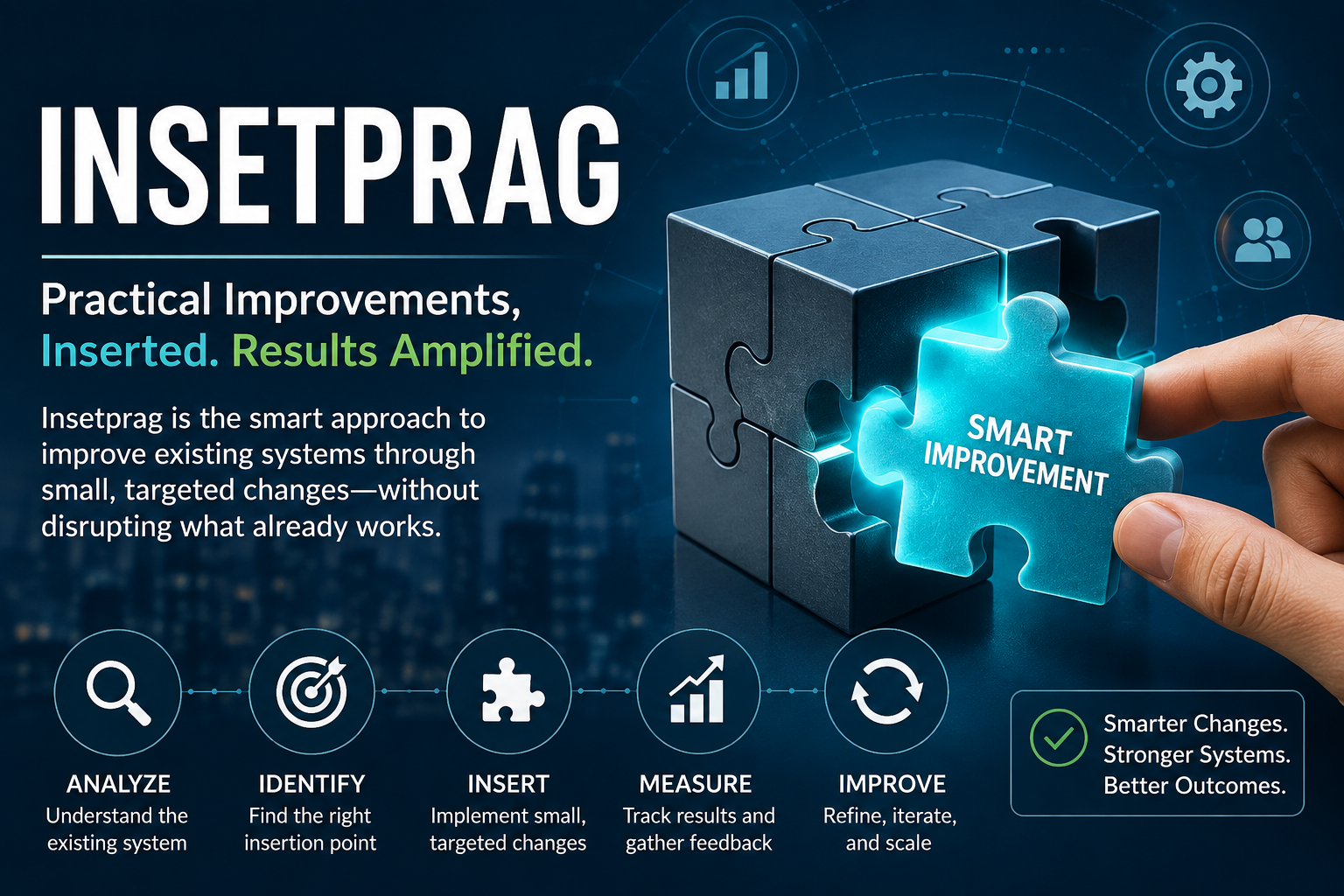
If you have searched for insetprag recently, you may have noticed something unusual: the word does not have one universally established definition. Current search results point to several different uses, including a Brazilian pest-control company called InsetPrag and a newer online interpretation of “insetprag” as a practical innovation or systems-improvement concept. That distinction matters because treating every result as though it describes the same thing can create a misleading explanation. In this guide, the focus is on the emerging conceptual meaning of Insetprag—the idea of embedding practical, targeted improvements inside an existing system—while also acknowledging that the term is used as a business name in other contexts. Recent articles describing the concept generally interpret the name as a combination of “inset,” suggesting something placed or embedded within another structure, and “prag,” associated with pragmatic or practical thinking. So, rather than pretending that Insetprag is already a universally standardized academic discipline, it is more accurate to understand it as an emerging label for a practical way of thinking about improvement, integration, and gradual change.
What Is Insetprag?
At its simplest, Insetprag describes the practice of making useful, practical improvements inside an existing system instead of immediately replacing that system from the ground up. Imagine an old house that still has solid foundations but needs better insulation, smarter lighting, a modern heating controller, and improved security. You could demolish the entire building and start again, but that would be expensive, disruptive, and unnecessarily risky if much of the original structure still works. An Insetprag-style approach asks a different question: where can you insert improvements so the existing system becomes significantly better without throwing away everything that already works? Recent online discussions of the term emphasize precisely this combination of embedded change, practical feasibility, contextual awareness, and iterative improvement. The concept therefore sits comfortably beside ideas such as continuous improvement, incremental modernization, systems thinking, lean experimentation, and modular technology, although it should not automatically be treated as a formally recognized replacement for any of those established methodologies.
There is another reason the definition needs care. Search results for “Insetprag” are not perfectly consistent, and one prominent current result identifies InsetPrag as a pest-control and drain-service business operating in Pedro de Toledo and São Paulo, Brazil. Its website lists services including pest control, rodent control, termite control, environmental sanitization, water-tank cleaning, drain services, hydrojetting, and waterproofing. That means someone searching the exact term could have a very different intent: they might be looking for a company rather than a conceptual framework. The older Insetprag.com result also previously presented itself as a general-interest publishing platform covering entertainment, fashion, business, technology, news, travel, health, and lifestyle, although that domain currently displays an expired-domain notice. For SEO purposes, this ambiguity is important because search intent should determine the content you create rather than forcing unrelated meanings into one definition.
The Meaning Behind the Name
The conceptual interpretation of Insetprag becomes easier to understand when the word is broken into its apparent components. “Inset” commonly suggests something inserted, embedded, or positioned within an existing structure, while “prag” is commonly interpreted online as a shortened reference to pragmatic thinking. A number of recent articles use this exact interpretation when describing Insetprag as a method of placing practical improvements inside existing systems rather than replacing those systems completely. Think of it like upgrading a bicycle instead of buying a new one every time you want a better ride: perhaps you change the tires, improve the brakes, adjust the gears, and replace a worn component, while keeping the frame that still serves you well. The strength of the idea is therefore not the word itself but the question behind it: what is the smallest meaningful intervention that can produce a useful improvement? That question can apply to software, business processes, education, personal productivity, infrastructure, and many other environments where complete replacement is either impossible or undesirable.
Why Context Matters
Context is the part of Insetprag that prevents the idea from becoming a simplistic slogan about “small changes.” A small change is not automatically a good change; the value depends on where, why, when, and how the change is introduced. Adding another software dashboard to an already overloaded team may technically be a small intervention, yet it could make the workflow worse because it creates another place for employees to check information. By contrast, automating one repetitive approval step might remove hours of unnecessary work without forcing employees to learn an entirely new system. Recent descriptions of the Insetprag framework emphasize context awareness alongside micro-interventions, feedback loops, feasibility, and scalability, which makes the concept more sophisticated than simply “make tiny changes.” The practical lesson is straightforward: before inserting anything, understand the system you are changing, identify the bottleneck that actually matters, and determine whether the intervention improves the whole workflow rather than merely one isolated component.
Why Insetprag Is Getting Attention
The appeal of Insetprag is closely connected to a problem that businesses and institutions face every day: large transformations are often necessary, but large transformations are also difficult. Replacing a legacy platform, restructuring an organization, moving to a new operational model, or rebuilding infrastructure can consume substantial money, time, training, and management attention. Even when the final result is better, the journey can be painful because employees must operate during the transition while learning unfamiliar processes. Recent discussions of Insetprag present gradual intervention as an alternative way to balance innovation with operational stability. The attraction is obvious: instead of asking, “How do we replace everything?” leaders can ask, “What should we improve first, and what evidence would tell us that the improvement worked?”
That mindset is especially relevant in an environment where technology changes faster than many organizations can rebuild their foundations. A company may already have an accounting platform, customer database, internal communication tools, reporting systems, and years of historical data. Throwing all of those assets away simply because a newer technology exists may create more problems than it solves. An incremental strategy can allow the organization to add automation, integrations, analytics, or user-interface improvements while preserving stable components. The same principle applies outside technology: a school can improve one classroom process before redesigning its entire curriculum, a hospital can streamline one administrative workflow before replacing its whole information environment, and a small business can automate one repetitive task before purchasing an expensive enterprise platform. Insetprag is attractive because it frames modernization as a series of manageable decisions rather than one enormous bet.
Insetprag and Practical Innovation
Practical innovation is the heart of the concept. Innovation is often presented as something dramatic: a revolutionary product, a disruptive platform, or a complete transformation that changes an industry overnight. Real organizations, however, usually improve through dozens of less glamorous decisions. A better form, a faster approval process, a useful integration, a clearer customer message, or an automated report can each produce modest gains that become significant when combined. Insetprag puts that kind of grounded innovation at the center by emphasizing interventions that can be tested in real conditions rather than ideas that remain impressive only in presentations. Contemporary descriptions of the concept repeatedly highlight feasibility, iteration, measurement, and gradual scaling as important characteristics.
The distinction between innovation and practical innovation is worth remembering. A brilliant idea that nobody can afford to implement is not particularly useful to the organization that needs results this quarter. Likewise, a technically sophisticated solution that employees refuse to use may look impressive on paper while producing little operational value. An Insetprag perspective asks whether an improvement fits the available resources, people, infrastructure, risk tolerance, and actual problem. That makes the approach naturally compatible with experimentation: make a focused change, observe what happens, gather feedback, improve the intervention, and only then consider expansion. The objective is not to make change smaller for its own sake; the objective is to make change more testable, controllable, and useful.
Core Principles of Insetprag
Several principles consistently appear in current explanations of Insetprag. The first is micro-intervention, meaning that improvement begins with a focused change rather than a complete reconstruction. The second is context awareness: the intervention must fit the system into which it is inserted. The third is iteration, because the first version of a solution rarely deserves to be treated as final. The fourth is feasibility, which means considering money, time, technical limitations, skills, and operational realities before committing to an idea. The fifth is scalability, because a useful small improvement should ideally provide a path toward broader benefits if evidence supports expansion. These principles create a useful mental model: understand first, intervene carefully, measure honestly, learn quickly, and scale only when the evidence justifies it.
Small Changes With Measurable Impact
The phrase small changes can be misunderstood. Insetprag does not mean making random cosmetic adjustments or constantly tinkering with a system without a strategy. A meaningful intervention should be connected to a specific problem and ideally have a measurable outcome. Suppose an online retailer discovers that customer-service employees spend too much time manually copying order information between systems. An Insetprag intervention might be a small integration that automatically transfers the relevant data. The change is narrow, but the effect can be measured through handling time, error rates, employee workload, and customer response speed. If those indicators improve, the organization has evidence that the intervention deserves refinement or expansion.
This measurement component is what separates disciplined incremental improvement from endless experimentation. Without measurement, a team can easily confuse activity with progress: ten new features may be launched while the underlying customer problem remains untouched. A good intervention should therefore have a clear baseline and a meaningful success criterion. Recent descriptions of Insetprag specifically emphasize testing, feedback, monitoring, refinement, and scaling after successful pilots. In practical terms, that means asking three questions before implementation: What problem are we solving? How will we know whether it improved? What will we do if the result is worse than expected? Those questions turn a vague improvement project into an evidence-driven process.
How Insetprag Works in Practice
An Insetprag workflow can be understood as a repeating cycle rather than a one-time project. First, map the existing system and identify a meaningful weakness. Next, locate the point where a relatively focused intervention could address that weakness. Then introduce the smallest viable improvement, measure the result, gather feedback, and decide whether to refine, reverse, or expand it. Current descriptions of the framework follow a broadly similar pattern, moving from system analysis to insertion points, pilot implementation, measurement, refinement, and eventual scaling. The beauty of this process is that it creates a feedback loop: instead of pretending to know everything before acting, the organization learns from action while keeping the scope of each experiment manageable.
The approach also changes the way teams think about risk. A full replacement concentrates risk into one massive decision, while incremental intervention distributes learning across smaller decisions. That does not eliminate risk—nothing does—but it can make failures easier to detect and contain. If a small automation experiment causes unexpected problems, the team can correct or remove it before it becomes deeply embedded across the organization. If the intervention succeeds, the organization gains evidence and confidence for the next step. In that sense, Insetprag resembles stepping stones across a river: each stone provides enough stability to move forward, while the route can be adjusted as you discover what lies ahead.
Finding the Right Insertion Point
Finding the right insertion point is arguably the most important skill in an Insetprag approach. Not every part of a system deserves intervention, and changing a visible component does not necessarily address the real bottleneck. Teams should look for areas where friction is repeated, costly, measurable, and connected to a meaningful outcome. A process that consumes five minutes once a month is unlikely to be a priority, while a process that wastes five minutes on every transaction may deserve immediate attention. This is why process mapping and observation matter before implementation: you need to see how work actually happens rather than relying solely on how a process is supposed to happen.
A useful insertion point also needs enough flexibility to accept change. If a legacy application has no supported integration mechanism, adding a sophisticated automation layer may create more complexity than value. In contrast, an existing API, export process, workflow trigger, or modular component could provide a natural location for improvement. The same principle applies to nontechnical systems. In education, the insertion point might be a short assessment placed inside an existing lesson; in business, it might be an automated approval notification inside an established workflow; in operations, it could be a sensor added to existing equipment. The goal is to work with the structure of the system, not against it.
Insetprag in Technology and Software
Technology is one of the clearest environments for the Insetprag idea because many organizations depend on legacy systems that cannot simply disappear overnight. Current articles describing the concept point to APIs, microservices, integrations, automation, cloud technologies, and gradual modernization as examples of how functionality can be added without replacing an entire platform. Consider a company whose core business application still performs essential financial tasks but lacks modern reporting. Instead of replacing the entire application, the company might add a reporting layer that extracts approved data, transforms it, and presents useful dashboards to decision-makers. The underlying system remains in place while the organization gains a new capability around it.
This approach can also help technical teams separate stability from innovation. A stable legacy component may not be exciting, but if it reliably performs an essential function, replacing it purely for aesthetic reasons may be unjustified. An incremental architecture allows teams to modernize the areas that create the most friction while leaving dependable components alone until replacement becomes genuinely worthwhile. The challenge, of course, is avoiding a tangled collection of patches. Insetprag works best when each insertion has a clear purpose, ownership, documentation, security review, and architectural relationship with the rest of the environment. Otherwise, “gradual improvement” can quietly turn into technical debt wearing a nicer name.
Insetprag in Business and Operations
For business operations, Insetprag can be especially useful because operational systems are often full of small inefficiencies that accumulate over time. An employee might manually enter the same information into three applications, managers might approve requests through long email chains, or customers might repeatedly provide information that the business already possesses. None of these problems necessarily requires a revolutionary transformation. A targeted automation, integration, form redesign, or notification system may remove the friction while leaving the broader operating model intact. Current descriptions of Insetprag specifically identify workflow optimization, collaboration, decision-making, and operational improvements as suitable areas for the approach.
The human side of business transformation is equally important. Employees are often more comfortable with improvements that solve an obvious problem without forcing them to abandon familiar tools overnight. A small change can therefore function as a bridge between the current state and a future operating model. Imagine a sales team that already uses a CRM but spends hours preparing weekly reports manually. Adding automated reporting does not require the team to learn an entirely different CRM; it simply removes a painful step from the workflow. When employees experience a direct benefit, adoption can become easier because the change feels like assistance rather than another corporate mandate.
Insetprag in Education and Learning
Education offers another interesting application because learning systems are rarely changed successfully through technology alone. A school can purchase sophisticated software, but if teachers cannot integrate it naturally into classroom routines, the investment may deliver disappointing results. An Insetprag-style approach would begin with the existing learning environment and identify one specific opportunity for improvement. That might mean embedding a short digital assessment into an established lesson, adding targeted feedback to an existing assignment process, or introducing a small learning tool that supports a known weakness rather than replacing the entire instructional model.
The concept of incremental intervention also fits the reality of how people learn. Large amounts of information delivered at once can be difficult to absorb, while focused learning activities can be inserted into existing routines. Current descriptions of Insetprag mention microlearning as an example of embedding modern learning methods into established educational activity. The important point is not that every educational problem should be solved through microlearning, but that improvements can be designed around the context in which students and teachers already operate. A successful intervention should make learning clearer, more accessible, or more effective rather than simply adding another digital distraction.
Insetprag in Healthcare and Complex Systems
Healthcare illustrates both the promise and the difficulty of incremental systems improvement. Hospitals and clinics rely on complicated combinations of clinical processes, administrative systems, patient records, scheduling, communication, equipment, and regulatory requirements. A complete replacement can be extraordinarily disruptive, which makes targeted integration and workflow improvements attractive in principle. Recent online explanations of Insetprag describe healthcare applications such as integrating new technologies with existing systems and improving information management without requiring a complete infrastructure overhaul. In a high-stakes environment, however, “small” must never be confused with “casual”: every intervention requires appropriate testing, governance, security, and professional oversight.
The value of the concept here is primarily architectural and operational rather than clinical. A hospital might improve appointment coordination, reduce duplicate data entry, or make information easier for authorized staff to access while preserving core clinical systems. The improvement can then be assessed through appropriate operational indicators such as processing time, error frequency, user satisfaction, or workflow reliability. Because healthcare involves sensitive information and safety-critical decisions, cybersecurity and governance become particularly important. Insetprag can encourage gradual change, but it does not remove the need for rigorous standards; if anything, the more complex the system, the more disciplined the insertion process needs to be.
Insetprag vs. Traditional Transformation
The biggest difference between an Insetprag-style approach and a traditional “rip-and-replace” transformation is the unit of change. Traditional transformation often begins with a desired future state and works backward toward a major implementation. Insetprag starts with the existing state and asks where practical interventions can create measurable progress. Recent sources describing the concept contrast gradual, embedded improvements with complete system overhauls that may require larger investments and greater disruption. Neither strategy is universally superior. If an existing system is fundamentally unsafe, obsolete, unsupported, or incapable of meeting essential requirements, replacement may be the responsible choice.
| Approach | Insetprag-style improvement | Full transformation |
|---|---|---|
| Starting point | Existing system | New target state |
| Change size | Small or modular | Large-scale |
| Disruption | Usually lower | Often higher |
| Learning | Continuous | Often concentrated around implementation |
| Investment | Incremental | Frequently substantial upfront |
| Risk profile | Distributed across interventions | Concentrated in major transition |
| Best fit | Systems that still work but need improvement | Systems that must fundamentally change |
The practical decision is therefore not “Which philosophy is always right?” but “What kind of change does this system actually require?” A business with a functioning platform and a few painful bottlenecks may benefit from incremental intervention. A business whose core architecture cannot support its regulatory, security, or customer requirements may need a deeper transformation. Insetprag becomes most useful when it helps decision-makers avoid unnecessary disruption while still recognizing when incremental fixes have reached their limits.
Benefits of the Insetprag Approach
The potential benefits of Insetprag follow naturally from its incremental design. Organizations can potentially reduce disruption because changes are introduced in smaller units. They can also learn earlier because each intervention creates an opportunity to observe real results before committing to a larger rollout. Current discussions of the framework identify lower costs, faster results, reduced disruption, improved adoption, flexibility, and scalability among its proposed advantages. These are not guaranteed outcomes, however; they depend on whether the intervention addresses a genuine problem and whether the organization manages the change intelligently.
Another benefit is psychological. Large transformation programs can create fatigue because employees hear about future-state visions for months while continuing to deal with immediate operational problems. Small improvements can create visible evidence that change is actually helping. When an employee sees a repetitive task disappear or a customer receives a faster response, transformation becomes tangible rather than theoretical. Over time, these wins can create momentum. The metaphor of compound interest works well here: one small improvement may not seem dramatic, but a sequence of well-chosen improvements can create a substantial difference.
Challenges and Limitations
Insetprag is not a magic formula, and its biggest danger is fragmentation. If an organization keeps inserting isolated solutions without maintaining an overall architecture, the result can become a maze of integrations, exceptions, tools, and workarounds. Recent discussions of the concept explicitly identify fragmentation, legacy-system integration, strategy, learning curves, and data security as challenges. A system can therefore become worse if every department independently adds its own “small improvement” without considering how those improvements interact. The solution is not to abandon incremental change but to combine it with governance, documentation, ownership, architecture standards, and periodic system-level reviews.
There is also a risk of optimizing the wrong thing. A team might reduce the time required for one internal task while failing to address the larger customer or business problem. Another risk is endless incrementalism: leaders may keep patching a failing system because each individual fix looks cheaper than replacement, even when the cumulative cost has become unreasonable. Insetprag should therefore include a threshold question: when does improvement stop being pragmatic? If an intervention requires another intervention to repair its side effects, and another to connect the previous two, the organization may be approaching the point where a deeper redesign is more sensible.
How to Implement Insetprag Step by Step
Implementing the concept does not require a complicated proprietary framework. Start by documenting the system as it actually operates, including the people, tools, dependencies, bottlenecks, and recurring sources of friction. Then rank potential problems according to impact, frequency, feasibility, risk, and measurability. Choose one insertion point rather than attempting to solve everything simultaneously, define a baseline, and establish a specific success criterion. Current descriptions of Insetprag similarly recommend analyzing the existing system, identifying insertion points, creating small solutions, piloting them, measuring results, refining them, and scaling successful interventions.
Once the pilot is running, resist the temptation to declare victory too early. Compare the new process with the baseline, collect feedback from actual users, and look for unintended consequences. If the result is positive, improve the intervention and determine whether it should expand. If the result is mixed, identify what caused the weakness rather than automatically scaling it. If the intervention fails, remove it where practical and document the lesson. This creates a culture in which failure is useful information rather than something employees feel compelled to hide. The ultimate objective is not to maximize the number of changes but to maximize validated improvements.
Real-World Examples of Insetprag
Consider a retailer whose customer-service team manually searches several systems every time a customer asks about an order. A full transformation could involve replacing the CRM, order management system, customer portal, and reporting infrastructure. An Insetprag approach might instead create a secure integration that surfaces the most important order information in the system employees already use. The organization can then measure handling time, error rates, and customer satisfaction before deciding whether additional integration is worthwhile. This example reflects the broader pattern described in current Insetprag literature: insert functionality into an existing environment, test the effect, and expand only after evidence supports the decision.
A second example could involve a manufacturing operation. Suppose managers want better visibility into equipment performance but do not want to replace every machine. Rather than rebuilding the factory, they could introduce sensors to a limited group of machines, collect performance information, and evaluate whether predictive maintenance or energy monitoring produces useful results. If the pilot demonstrates value, the system can gradually expand. The same logic can apply to smart-city infrastructure, internal business workflows, educational programs, and software modernization. The common denominator is not the industry; it is the pattern of embedding a targeted capability into something that already exists.
Insetprag, AI, and Automation
Artificial intelligence makes the Insetprag concept particularly interesting because AI can be introduced at many different layers without necessarily replacing an entire system. A business could begin by using AI to classify incoming support requests, summarize internal documents, detect anomalies in operational data, or draft routine communications while leaving the primary business applications unchanged. Current 2026 discussions of Insetprag identify AI, automation, real-time analytics, cloud systems, sustainability, and cybersecurity as areas likely to influence the concept’s evolution. The strongest applications are likely to be those where AI solves a specific, measurable problem rather than being added simply because “AI” appears on a technology roadmap.
The same caution applies here as elsewhere. An AI tool can create impressive outputs while introducing privacy, security, accuracy, bias, or governance problems. An incremental deployment allows an organization to evaluate these issues in a controlled environment before expanding usage. For example, an internal document-summarization assistant could initially operate on a limited collection of approved documents with human review before becoming available across the organization. That is an Insetprag-style deployment because intelligence is being inserted into an existing workflow rather than forcing everyone onto a completely new operating model. The technology may be sophisticated, but the implementation remains deliberately practical.
The Future of Insetprag
The future of the term itself is difficult to predict because Insetprag remains an emerging and inconsistently defined expression rather than a universally standardized methodology. Some recent articles treat it as a systems and innovation framework, while other search results use the name for unrelated organizations or websites. That means its long-term value will depend less on whether the word becomes fashionable and more on whether the underlying principles prove useful. Ideas such as incremental modernization, contextual decision-making, continuous improvement, modular architecture, and experimentation already have established histories, so Insetprag will need to offer a sufficiently clear and useful synthesis to earn durable recognition.
The underlying philosophy, however, is unlikely to disappear. Organizations will continue to operate legacy systems, budgets will remain constrained, technology will continue to evolve, and people will still resist unnecessary disruption. Those conditions create a permanent need for methods that balance improvement with stability. Whether people eventually call that process Insetprag, incremental transformation, adaptive modernization, or something else is almost secondary. The valuable question remains the same: Can we improve what already exists without creating more problems than we solve? If the answer is yes, then the core idea behind Insetprag has practical relevance regardless of the label attached to it.
Conclusion
Insetprag is best understood as an emerging term for practical, embedded improvement rather than as a universally established technical standard. Current online sources commonly interpret the conceptual version of the word as combining the idea of inserting something into an existing structure with pragmatic, practical decision-making. Its central philosophy is straightforward: understand the existing system, identify a high-value insertion point, introduce a focused improvement, measure the result, learn from feedback, and scale only when the evidence supports expansion. That approach can be useful in technology, business operations, education, healthcare, infrastructure, and AI-enabled workflows, particularly when complete replacement would be expensive or disruptive.
At the same time, anyone researching “Insetprag” should pay attention to search intent because the exact name is also associated with a Brazilian pest-control and drainage-services business, while an older Insetprag domain has been used for a general-interest publishing site and currently shows an expired-domain notice. In other words, there is no single interpretation that should automatically be assumed from the keyword alone. For the conceptual meaning, the strongest takeaway is not the novelty of the name but the usefulness of its central question: where can a practical improvement be inserted to create meaningful value without unnecessarily rebuilding the entire system? Sometimes the smartest transformation is not a revolution. Sometimes it is one carefully chosen improvement after another.
Frequently Asked Questions About Insetprag
1. What does Insetprag mean in simple terms?
Insetprag is commonly described online as an approach to improving an existing system through small, practical, targeted interventions rather than replacing everything at once. The name is generally interpreted as combining “inset,” meaning something embedded or inserted, with “prag,” associated with pragmatic thinking. The important idea is to make improvements that fit the existing context, can be tested, and can be measured. It is therefore more useful to think of Insetprag as an emerging conceptual label than as a universally standardized technical term.
2. Is Insetprag an established technology or software platform?
Not necessarily. Current search results use the term in several different ways, and there is no clear evidence that “Insetprag” universally refers to one software platform. Some websites describe it as an emerging innovation framework, while the exact name is also used by a Brazilian pest-control and drainage company. If you encounter the term in a specific product, website, or industry, the surrounding context should be checked before assuming that it refers to the conceptual framework.
3. What are the main principles of Insetprag?
The principles most frequently associated with the conceptual interpretation include small interventions, context awareness, practical feasibility, iteration, feedback, measurement, and scalability. Together, these principles encourage organizations to understand their current environment before introducing changes. The goal is not to make changes merely because they are small; the goal is to make changes that are focused, useful, measurable, and appropriate for the system.
4. Can small businesses use the Insetprag approach?
Yes, the underlying approach can be particularly practical for small businesses because they often cannot afford major technology replacements or lengthy transformation programs. A company could start by automating one repetitive administrative task, improving one customer-service workflow, integrating two existing tools, or simplifying one internal process. The key is to select an improvement that addresses a genuine bottleneck and produces a measurable benefit. Once the first change works, the business can decide whether additional improvements are justified.
5. Is Insetprag better than completely replacing an old system?
Not always. Insetprag-style incremental improvement is most appropriate when the existing system still provides valuable functionality and can be improved without unacceptable technical or operational compromises. If a system is fundamentally insecure, unsupported, legally unsuitable, or incapable of meeting essential requirements, complete replacement may be more appropriate. The real strength of the Insetprag philosophy is therefore not that it rejects transformation, but that it encourages decision-makers to earn the case for larger transformation through evidence rather than assuming that rebuilding everything is automatically the best solution.